Space Technology Series: Satellite Manufacturing
Alex Chicote · 2024-04-09
When the first satellite entered orbit in 1957, the veil of space lifted, if ever so slightly. The collective minds of Earth’s innovators raced as the perceived threshold for our technical capabilities blew wide open.
Communication and knowledge transfer at the speed of light.
Accuracy of GPS and observations down to the meter. Access not only for the few, but for all. Slowly, but surely, it changed the way we lived - the pace accelerating continuously as the years rocketed past.
One day, the lens of focus will flip from Earth to space. We know not what will reflect back.
But, it’s not prudent to ponder the distant future for too long. It is the steps we take today that make this possible. Our near future holds enormous opportunities as well. Satellites that make connection with the world of the internet instantaneous anywhere on the planet no matter how inhospitable or remote. We have access to up to date comprehensive data that could hold the key to winning our race against climate change.
This is the business that makes space technology possible. Its capabilities have already proven itself to be profitable. In many ways, without it, the world of the internet could not exist. Because of satellites, we are free to dream of infinite possibilities, the stars twinkling in our eyes.
Artificial satellites have been launched into space for over half a decade with a wide variety of applications. As of May 2023, 7702 active satellites are in Earth orbit. The breakdown is as follows: 84% of satellites are in Low-Earth Orbit (LEO) at an altitude of 500-1000 km, 3% in Medium-Earth Orbit (MEO) at an altitude of 1000-15000 km, and 12% in Geosynchronous Orbit (GEO) with an approximate altitude of 36000 km.
Currently the largest applications include Communications and Earth Observation (GPS, geospatial intelligence). In this article we will discuss the basic vehicle architecture of a satellite, current trends in the satellite industry, and a case study.
For more information, you can read the Q&A interview linked below with Apex Space CEO, Ian Cinnamon.
What makes up a satellite?
A full spacecraft vehicle stack can be broken down into three main components: the satellite bus, power systems (solar wings), and the payload module. Bus-derived vehicles are typically bespoke, unique to each customer requirement and the mission at hand. Below is an in-depth breakdown of each major sub-system found on a vehicle.
Command and Data Handling: carries and stores data between units and ground control
Communications System: includes a receiver/transmitter for communication with terrestrial stations as well as inter-satellite comms (radio, antennas, etc)
Electrical Power System: solar panels frequently used to generate power, but also includes a battery system when primary power is not available
Propulsion: used for orbital adjustments and maneuvers in space, typically chemical propulsion but sometimes electric propulsion
Thermal Control: keeps the satellite’s environment within the range required to stay operational (temperature control)
Attitude Control System: keeps the satellite oriented correctly through the use of sun sensors/star trackers to determine orientation, and reaction wheels to adjust the orientation as needed
Guidance, Navigation, and Control System: figures out where the spacecraft needs to be/position in orbit, and adjusting the path of the spacecraft to meet mission requirements
What are the current trends in the satellite manufacturing industry?
Satellite Size
Satellites are often categorized by their mass:
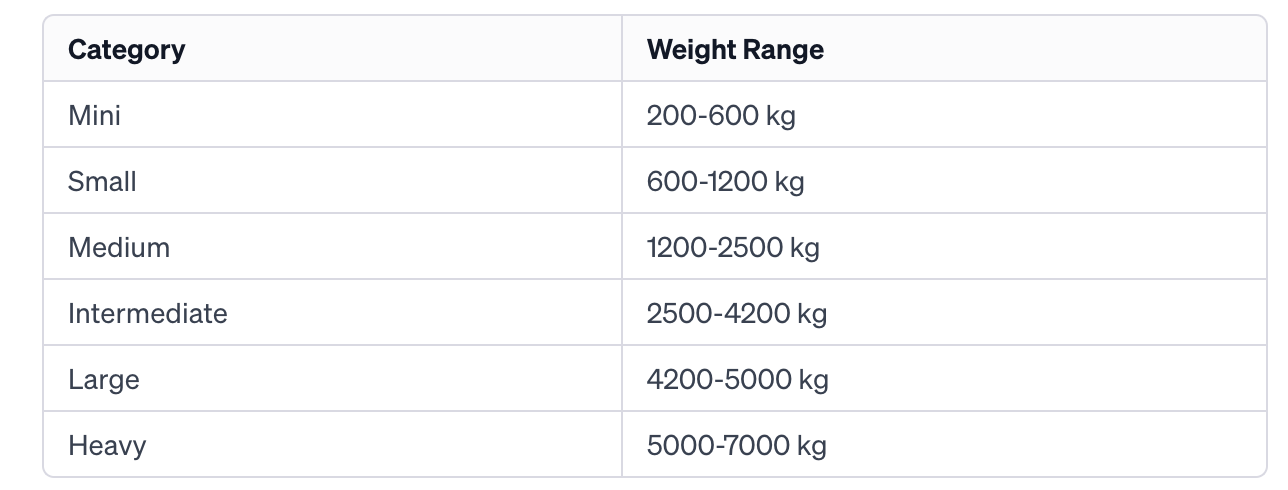
In the past decade, a recent trend has been a reduction in satellite mass but higher number of satellites, forming a “constellation” in orbit that works together to achieve the mission requirements. Small Sats require smaller rockets, can be built faster, and may have operational advantages (low-latency sats in LEO). This could be considered as the “r-selection” of the satellite industry (high-volume).
However, some evidence points towards a future trend in the opposite direction: steady growth in satellite mass, within constellations. This trend is driven by increased demand for higher throughput, better performance, and more power, all unlocked by greater launch capabilities and cheaper launch cost (think: Starship). It is possible for both trends to occur in some capacity; different markets/specializations could allow for this (could depend on mission requirements, orbit, and other factors).
Lifespan
A satellite’s lifespan is defined as the time between successful launch and end-of-life (primary payload failure, bus failure, or out of operational orbit) or retirement of the vehicle. Recently, design life for US military and civil satellites “has clustered around a long design life, over 11 years…with the overall trend of fewer satellite launches”.
Lifespan is also determined by fuel capacity. Satellites carry fuel to conduct orbital corrections and to de-orbit at the end of their mission. Operators are also looking for ways to extend lifespan, and companies like OrbitFab (see Q&A linked below) are working to develop on-orbit refueling to extend satellite lifespans.
A majority of satellites fall into the “too early to tell” category: these vehicles are still within their mission design life, and only time will tell which direction the actual vs design life trend will go.
Payload Applications
All objects in orbit serve to add value to society in one way or another. These can be grouped as:
- terrestrially-focused applications, or “Earth-bound”
- extraterrestrial-focused applications, or “space-bound”
The majority of Earth-bound applications fall into three categories: Communications, Global Navigation and Positioning (GNSS), and Earth Observation (EO). Communications applications include television, telephone, radio, internet and military. GNSS refers to a satellite navigation system with global coverage, providing continuous geopositional data in real-time. Operational GNSS systems include GPS (United States), Glonass (Russia), BeiDou (China), and Galileo (Europe). EO refers to the monitoring of land, ocean, and atmosphere through the use of remote sensors; applications include weather forecasting, deforestation monitoring, managing natural resources, and urban planning. Space-bound applications include: in-orbit services, in-space manufacturing, space observation, deep space exploration.
Case Study: K2 Space
K2 Space is a satellite manufacturing startup based in Los Angeles, CA developing large satellites that are taking advantage of expanded mass budgets resulting from heavy-launch vehicle availability. They are currently promising a three-months or less procurement to flight readiness timeline, with a production line process (and costs less than $15M cost per satellite).
For most manufacturers, more mass means more capabilities. K2 Space is following the demand: customers want more data, and they want it faster and with less waste. K2’s vehicles will have the power of high throughput satellites, payload volume of high resolution imaging satellites, and unit economics of small satellite constellations.
Current launch availability regimes have resulted in an upper limit on how heavy your satellite can be (mass budget). Launch services are also a significant portion of financial budgets, but with trending heavy-launch competition in the 2020’s, the price per kg of launch will fall and unlock further capabilities (more mass/power for the same price).
Starship, and hopefully other vehicles, will shift the paradigm for the satellite industry, and K2 Space is poised to take advantage of new opportunities in a fast-paced environment.
Economic Framework
The number of satellite launches has grown 10% annually with direct impacts on global communication infrastructure, the application that promises the largest near-term growth potential. Increased customer demand for internet access, television and radio broadcasts, and GPS are the main drivers for satellite growth.
The main costs are capital costs: building, launching, and maintaining a satellite or constellation. As previously mentioned, launch cost is historically the largest factor, ranging from tens of millions to hundreds of millions depending on the satellite size/complexity and the launch vehicle used.
New launch capabilities throughout the next decade help drive cost down for satellite operators, expanding opportunities (like K2 Space). Manufacturing costs are also dependent on vehicle design: size, complexity, but also on production strategy: constellation (economies of scale), standardized components, and promised schedule (quick-turn vs long-lead, etc).
Revenue is primarily generated from the sale of services (internet access, TV/radio, and GPS) from operators (owners of the satellite) to providers. For non-communication applications, revenue models depend on the industry applied: for example, climate change data is often sold to government entities (EPA, NOAA).
The satellite industry is ultimately about gaining additional insight through data, and having that data drive decision-making. The end customer, whether it be a user of internet/GPS services or a government looking for reconnaissance capabilities, drives the operator, manufacturer, and launch provider in the current industry environment.
Establishing a presence in Earth orbit has expanded the dimensionality not only of the information industry, but of humanity: we have moved beyond Earth’s two-dimensional surface and have introduced a new axis to the physical space our society’s infrastructure occupies.
For military applications, there exists the notion of “the ultimate high ground”: Earth orbit provides the ultimate vantage point, which is very attractive to militaries looking for any advantage that can be taken in national security.
This does raise concerns, of course. Should we allow the presence of military organizations to dominate space? What trajectory will this set us on regarding space settlement and exploration?
As mentioned, most current and near-future satellite applications are “Earth-bound”. At some point in the future, “space-bound” applications will have a significant impact on what gets built in space: new space stations? orbital settlements? factories in space?
Growing one should not come at the expense of the other - millions of bright minds are working towards using space to improve life on Earth and to unlock new opportunities for growth.
In the symphony of the cosmos, satellites are our opening notes, the beginning of a longer, more profound journey into the unknown. They are the tools that help us gaze further, dream bigger, and reach higher. And as we look towards a future where the lines between Earth-bound and Space-bound become increasingly blurred, we stand at the precipice of an era that promises wonders beyond our current imagining.